
A Guide to India’s Data Protection Law:         The Digital Personal Data Protection Bill, 2022


Background & Evolution of Privacy in India

A.  The journey of India’s Right to Privacy is more than 6 decades old, and it was only in the year 2017, the Apex Court of the land recognized and declared the “Right to Privacy” as a fundamental right enshrined under Article 21 of the Indian Constitution, 1950, in a landmark decision in  Justice K S Puttaswamy(Retd.), & Anr v UOI& Ors(2017). Little did we know, but this landmark decision changed the course of History.

B.  With the advent of the right to privacy as a fundamental right, a Committee of experts was set up in August 2017, for the purpose of preparing a draft report on Data Protection under the leadership of Justice B.N Srikrishna, (former) Judge of the Supreme Court. 

C. The Experts Committee submitted its report along with a draft version of the legislation in the year 2018 which was titled “Personal Data Protection Bill, 2018” (“PDP, 18”). The PDP, 18 was further analyzed and approved by the Cabinet Ministry on 4th December, 2019. Later, the draft version was introduced in the Lok Sabha, however, the title was changed to- Personal Data Protection Bill, 2019 (“PDP, 19”). 

D.  The PDP, 18 and PDP, 19 were drafted for the same purpose, but both had flaws that did not make them a comprehensive draft version of the law, and hence, none of them were adopted/passed. With the aim to make PDP, 19 more comprehensive, it was referred to a newly constituted committee i.e., Joint Parliamentary Committee (“JPC”).

E. The JPC on 16th December 2021 during the Winter session, released a recommendation report on the PDP, 19 with 81 amendments and 12 recommendations. The recommendation report was released after 2 years to the public and was renamed “the Data Protection Bill, 2021” (“DPB, 21”), with a widened scope of the bill in its entirety (inclusion of non-personal data, etc).

F.   However, the DPB, 21 was withdrawn in the Parliament in the month of August 2022 on the ground that the Government was working on a more comprehensive legal framework, and the present draft version did not allow it.

G. Surprisingly, on 18th November, a 4th draft version of the bill was introduced for public consultation. This time the title of the draft version has been changed to- The Digital Personal Data Protection Bill, 2022 (“DPDP, 22”)

The purpose of this article is to be a go-to guide for your understanding of the DPDP, 22. Here, we will not just summarize the entire draft bill, but highlight all the key provisions from an industry perspective.

PURPOSE:

The purpose of this legislation is to regulate the processing of digital personal data, to enable an individual to practice his/her right to privacy of their personal data, and to ensure that such processing is done for a lawful purpose. 

APPLICABILITY:

The law applies to the processing of “digital personal data” and excludes “offline personal data”, however, if such offline personal data is later digitized then the processing of such data would fall under the ambit of this Bill. 

Further, from the territorial scope of the DPDP, 22, it applies to data processing both within and outside the territory of India. For the law to apply outside the territory of India, it is essential that such processing of digital personal data is related to-

  • Any profiling of a Data Principal within the territory of India; or
  • Any activity pertaining to offering goods/services to users (Data Principal) inside the territory of India.

The provisions of the DPDP, 22 shall not apply to-

  • Any non-automated processing of personal data;
  • Offline personal data;
  • Processing, done by an individual for a personal/domestic purpose;
  • If the personal data of an individual has been existing in a record for at least 100 years.

Surprisingly, there is no classification of the personal data provided in the DPDP, 22. However, the sector-specific regulations in due time may establish additional requirements pertaining to safeguarding such personal data. Lastly, the DPDP, 22 does not apply to non-personal data as compared to its previous version.

CONSENT 

  • The DPDP, 22 under section 5 states the grounds on which the Data Fiduciary shall process the personal data of the Data Principal. The processing under the DPDP, 22 shall be considered lawful only when the Data Principal has given consent or the consent is deemed to have been given.
  • The DPDP, 22 under section 7 defines the concept of “Consent” and states- that when the Data Principal has freely given, a specific, informed, and unambiguous indication to a Data Fiduciary for processing their personal data for a “specific purpose.” However, the same must be shown through an affirmative action by the Data Principal.
  • Moreover, the DPDP, 22 under section 6 provides for a mandatory requirement that must be fulfilled by the Data Fiduciary on or before seeking the consent of a Data Principal. The Data Fiduciary is mandated to provide an itemized notice to the Data Principal in clear language, which shall contain the description pertaining to the data that is required to be collected from the user and the purpose behind it.
  • In the itemized notice that is issued for seeking/requesting consent from the Data Principal for processing their personal data, the contact details of the authorized person/data protection officer of the Data Fiduciary must be mentioned. The Data Principal shall have the right to access such itemized notice requesting consent in either English or any language specified in the Eighth Schedule to the Constitution of India.
  • It is also essential to note that any additional personal data which is not necessary for the performance and fulfillment of a contract/agreement between the Data Principal & Data Fiduciary. In such scenarios, the Data Principal shall be free to refrain from giving consent.

DEEMED CONSENT

Here are some instances mentioned in the DPDP, 22 wherein, it is presumed that the processing of personal data is based on Deemed Consent. Deemed consent has been discussed under section 8 of the DPDP, 22. At present the DPDP, 22 provides 9 instances wherein consent is considered as deemed, and they are-

  1. In an event wherein, the Data Principal voluntarily provides their personal data to the Data Fiduciary, and the same is reasonably expected from them;
  2. In an event, wherein, the processing is based on the performance of any function under law, or provision of any service, or benefit to the Data Principal/issuance of any certificate/license or permit to any action of the Data Principal by any State institutions or agencies;
  3. Processing done in relation to compliance with court order(s)/judgement(s);
  4. Processing done in relation to medical emergency pertaining to threat to life/health of the Data Principal or any other person;
  5. Processing done in relation to provide medical treatment/assistance to people during epidemic, outbreak, and/or any such threat to public health;
  6. Processing done in relation to taking safety measures for providing services to people during disaster, and/or breakdown of public order;
  7. Processing done in relation to employment-related purposes;
  8. Processing done on the grounds of public interest;
  9. Processing done for any fair and reasonable purpose- wherein the legitimate interests of the Data Fiduciary outweigh any adverse effect on the Data Principal, public interest and the reasonable expectations of the Data Principal.

It is essential to note here that the notice mentioned under section 6 is not mandated where deemed consent is given by the Data Principal.

CROSS-BORDER TRANSFERS

The DPDP, 22 also lays down a provision for the cross-border transfer of digital personal data. Although, it does not specify or name which countries/territories will be treated as “trusted geographies” for permitting the cross-border transfer of digital personal data. However, section 17 states that the Central Government will only allow and notify those countries/territories for cross-border transfers, based on an assessment as it may consider necessary.

EXEMPTIONS

Moreover, under section 18, there are some exemptions listed out, which simply means that the provisions of the DPDP, 22 shall not apply, except section 9(4)- which states that the Data Fiduciary and Data Processor shall take all the reasonable security measures in order to mitigate potential breaches. The exemptions have been listed below-

  • Wherein, processing such personal data is essential to enforce a legal right/claim;
  • Wherein, the processing of personal data is in the interest of prevention, detection, investigation/prosecution of any offence/contravention of any law;
  • Wherein, the processing of personal data is done by the court of law, tribunal, quasi-judicial body, etc;
  • Wherein, the personal data belongs to an individual outside the Indian territory and is processed based on a contract between an individual from outside the Indian territory and a person based in India.

The DPDP, 22 further permits the government to exempt any of its agencies from the application of this law on the ground-

  • In the interest of the sovereignty & integrity of India;
  • State’s security;
  • Friendly relations with foreign States;
  • Public order.

OBLIGATIONS OF Data Fiduciary

The DPDP, 22 under section 9 onwards up to section 11 states the obligations of Data Fiduciary. 

  • Under section 9– This provision deals with the general obligations, such as the Data Fiduciary shall be held solely responsible in relation to complying with this law, even in cases wherein the data is processed on behalf of them by Data Processors and/or by another Data Fiduciary.
  • ensuring that the personal data processed is accurate and complete especially when such data is likely to be disclosed to another Data Fiduciary and/or the data processed will be used to make decisions that affects the Data Principal itself.
  • The Data Fiduciary shall also implement both technical and organizational measures with the aim to ensure complete compliance with this law. The Data Fiduciary and Data Processor shall ensure that they take all the possible reasonable measures and safeguards to mitigate potential breach.
  • In an event of a personal data breach, the Data Fiduciary or the Data Processor (as the case may be), shall notify the Data Protection Board along with each affected Data Principal.
  • The Data Fiduciary shall ensure that the personal data of the Data Principal is not retained once the purpose behind such processing is fulfilled, and/or where retention of the data is no more required for any legal/business purpose.
  • The Data Fiduciary is also required to publish the contact details of the data protection officer or the authorised personnel who may answer on behalf of the Data Fiduciary to all such questions/queries posed by the Data Principals pertaining to the processing of their personal data. They are also required to ensure a mechanism is at place that shall focus on grievance redressal.
  • Under section 10– These provisions lay out the additional obligations of the Data Fiduciary pertaining to the processing of children’s personal data.
  • Under the DPDP, 22 for processing of a child’s (anyone who has not completed 18 years of age) personal data, the Data Fiduciary is mandated to seek the parental consent, and only after obtaining the same, they may process the child’s data.
  • Furthermore, a Data Fiduciary shall not process a child’s personal data in scenarios where such processing will likely cause harm to that child.
  • A Data Fiduciary shall not track nor monitor a child’s behviour or direct targeted advertising upon a child.
  • Under section 11–  This provision states the additional obligations of a Significant Data Fiduciary. However, before getting into the obligations, we need to understand who exactly falls under the ambit of a “Significant Data Fiduciary.” 
  • A Significant Data Fiduciary is any Data Fiduciary or a class of data fiduciaries that are notified by the Central Government. They shall be notified based on some factors such as- the amount of personal data that is being processed; the risk of harm that the Data Principals are likely to face; its impact on the integrity & sovereignty, security, and public order of the nation.
  • Furthermore, a Significant Data Fiduciary is required to appoint a Data Protection Officer, and an independent Data Auditor, and is further mandated to take measures such as Data Protection Impact Assessment, etc.

RIGHTS & DUTIES OF Data Principal

The rights and duties of the Data Principal have been laid down in Chapter 3 of the DPDP, 22 starting from section 12 up till section 16. Here is the list of rights mentioned under section 12

  1. The Data Principal shall have the right to seek confirmation from the Data Fiduciary on whether their data has been processed or is being processed by them;
  2. The data subject shall have the right to seek the summary of their data that has been processed or is being processed by the Data Fiduciary;
  3. The Data Principal shall have the right to know with whom all the Data Fiduciary has shared their personal data, along with the categories of personal data that has been shared.

Under section 13– The Data Principal shall have the right to correction and erasure of their personal data that is with the Data Fiduciary.

Under section 14–  The Data Principal shall have the right to seek grievance redressal by registering a grievance with the Data Fiduciary. Moreover, if the Data Principal is not satisfied with the response, or does not receive any response from the Data Fiduciary, then in such scenarios, the Data Principal may register the complaint at the Data Protection Board.

Under section 15– The Data Principal shall have the right to nominate anyone, who shall exercise the rights of a Data Principal under the DPDP, 22 after the death/incapacity of the Data Principal.

Under section 16– The Data Principal is obliged under DPDP, 22 to perform certain duties such as-

  1. Shall ensure that they do not register any false/frivolous complaint with the Data Fiduciary and/or at the Data Protection Board;
  2. Shall not furnish false documents, impersonate another person, and/or suppress information while applying for any document, service, proof of identity, etc.
  3. While exercising their rights under section 13 pertaining to correction and erasure, Data Principal shall furnish verifiable and authentic information.  

DATA PROTECTION BOARD OF INDIA

The DPDP, 22 also proposes to establish a Board i.e., the Data Protection Board of India to pronounce decisions against complaints filed by Data Principals, to impose penalties for non-compliance not exceeding Rs. 500 crores, and perform all such functions as and when notified by the Central Government in due time.

PENALTIES

Here are the financial penalties listed out under schedule 1 of the DPDP, 22 for non-compliance with the provisions of the law.

  1. In an event, wherein the Data Fiduciary or Data Processor fails to take reasonable security measures in order to mitigate/prevent a data breach. For such incidents, a penalty of up to Rs. 250 crores shall be imposed.
  2. Where the Data Fiduciary fails to notify the Data Protection Board & the affected Data Principals about the breach. For such incidents, a penalty of up to Rs. 200 crores shall be imposed.
  3. In an event, wherein the Data Fiduciary fails to comply with the additional obligations pertaining to the processing of a child’s personal data (section 10). For such incidents, a penalty of Rs. 200 crores shall be imposed.
  4. Wherein, the Significant Data Fiduciary fails to comply with the additional obligations mentioned under section 11. In such scenarios, a penalty of up to Rs. 150 crores shall be imposed.
  5. In an event, wherein a Data Principal fails to comply with the duties mentioned under section 16. In such scenarios, a penalty of up to Rs. 10 thousand shall be imposed.
  6. Non-compliance with the provisions of the DPDP, 22 except for those listed above, shall lead to a penalty of up to Rs. 50 crore.

Privacy concerns abound in the official Beijing 2022 Winter Olympics app

Introduction

The 2022 Winter Olympics were held in Beijing, China from 4th Feb-20th Feb 2022. Even before the start of the Winter Olympics 2022, China was being criticised and accused of allegations pertaining to human rights violations and other related controversies globally. Around 180 human rights groups were of the opinion that all the leaders globally and the governments should boycott the Winter Olympics in Beijing as the Chinese government was held solely responsible for the genocide of the minority communities in China. The Canadian government along with the UK and the United States government were the ones who decided to diplomatically boycott the games; this meant that these countries would only send their athletes to be a part of the games, whereas the government delegates and officials won’t either attend the games or be a part of the event.

But was this the only issue raised by the officials?

The other issue that was largely concerning the majority and the same was being discussed everywhere from news channels to even the U.S Olympics and Paralympics committee was related to the ‘privacy’ of the athletes as well as the ones who were planning to attend the games in Beijing.

The catch to this privacy-related issue is that those who were preparing to attend the 2022 Winter Olympics had to compulsorily download a mobile application called “MY2022”. This app had multiple security flaws and resulted in privacy concerns that were very much applicable to both the domestic as well as international athletes along with the ones who were merely attending. 

What is MY2022?

MY2022 is a mobile application that was made a requirement for all the athletes and the attendees of the Winter Olympic Games. The app performs multiple functions right from real-time chat with your contacts along with that video and audio options are also available for the users; users have the option to even share files with each other, as well as the app notifies its users about the weather and news updates. Furthermore, the app is also used to submit health customs information of those who are visiting China from other nations. This includes submitting the user’s passport details, demographic information along with travel, medical history (if any), COVID-19 vaccination status, and lab test results including users’ daily health status.

China’s intention behind collecting this information as per their official statements was to prevent the transmission of COVID-19 and hence was a part of the COVID protocol that was being followed during the Winter Olympics.

It was prescribed that all the athletes and attendees should download the app 14 days prior to their visit to China, and were required to monitor and submit their health information in order to track their health status on a daily basis. Many countries have relied on similar apps in order to track the health status of their citizens and the foreign travelers, especially if we take India as an example here, the app named ‘Aarogya Setu’ was extensively used and is even used today in order to monitor the health status of the people in India.

As per the Chinese government’s guide on the Olympic games, it was discovered that the MY2022 app was created by the Beijing Organising Committee for the 2022 Winter Olympics. However, later through public records and the App Store’s information, it was revealed that the owner of the app is a state-owned company called the ‘Beijing Financial Holding Groups’. continue reading

A quick guide on the concept- Privacy by Design

Introduction

The concept of data privacy has been in papers way before the coming of the digital era, and so does the concept of Privacy by Design, which was introduced in the 90s by Ann Cavoukian, former Information and Privacy Commissioner for the Province of Ontario.

Privacy by Design (“PbD”) defines the nature of Privacy and how we must approach it. It means that at the beginning of an organization or a project’s existence, privacy must first be implanted, enabled and implemented into its very own foundation. Rather, than just looking at it from a compliance point of view and merely as a remedy against breaches and risks. Moreover, it should be adopted as a culture, and not as an add-on to your shopping cart list.

Let’s dive into how to implement PbD within an organization with its Seven foundational principles-

  1. Privacy measures should be “Proactive not Reactive”; “Preventive not Remedial”

Taking this viewpoint, it can make your team’s life easy and save your organization from huge penalties, here’s why- This principle discusses the very nature of privacy, and how it benefits and add value to an organization when it is proactively utilised. The reasoning behind the implementation of privacy should be to detect and minimize/eliminate potential threats, not wait for the potential threats to cause harm first, and then implement security measures. That’s not how privacy should work. An example of this could be- Conducting a Data Protection Impact Assessment before processing or Transfer Impact Assessment before cross-border transfers.

  • You must enable “Privacy as the Default setting”

This simply means that privacy must be implemented into the systems and processes as a default setting and by putting privacy at the forefront. Although, this looks the toughest to crack, however, it only minimizes the potential cyber risks. By enabling privacy as a default setting, your organization aims to achieve this by limiting the collection of data, not retaining the data after its purpose and ensuring that no users are required to act separately to protect their personal data. For example- having the personalised ads or precise location option turned off as a default setting.

  • “Privacy embedded into Design”

Privacy must be implemented into the skin of the products/services that you offer from its initial stage. It should be treated as an integral part of your business practice. Lastly, it shouldn’t be considered an add-on or a strategy taken as countering measures against risks. In simple terms, this principle states that an organization must thrive to provide privacy at all stages while offering the users with its products/services. For example, ensuring an end-to-end encrypted platform, giving users the choice of receiving targeted ads, etc.

  • Full Functionality – Positive-sum, Not Zero-sum

The fourth principle simply states that privacy by design is an approach which seeks to accommodate all legitimate interests, dismissing unnecessary trade-offs, and avoids all such false dichotomies such as privacy v security, etc, ensuring that by implementing privacy by design an organization could achieve a win-win scenario. For example, if an organization limits and minimizes data collection and data sharing, and destroys it according to its retention policy. This can ensure fewer security flaws, and enable users’ privacy to be at the forefront, without making any unnecessary trade-offs.

  • End-to-End Security – Full Lifecycle Protection

This principle simply states that data privacy & protection goes hand in hand, and shall be delivered during the entire lifecycle of the data. An organization must ensure all reasonable security measures are taken that are industry-recognized right from data collection to deletion. For example- During a cross-border transfer of personal data, an organization must conduct a transfer impact assessment in order to assess and analyse the potential risks, and only then move ahead with such transfers.

  • Visibility and Transparency – Keep It Open

This principle lays out that the privacy of the users means complete visibility and transparency of their data. To ensure this every organization must thrive to have easy-to-ready privacy and cookie policies. This could help users to understand exactly what happens with their data. Always remember, privacy is a trust-building initiative and has a direct impact on every organization.

  • Respect for User Privacy – Keep It User-centric

And, lastly, privacy only comes by putting consumers/users at the top. Organizations must keep in mind that at last they are processing their users’ data, and must ensure to keep it consumer-centric by granting them control and visibility over their data. Data privacy should come in line with respecting the users’ experience throughout. For example- a user must have the right to seek correction & erasure of his/her data from any platform.

What is DMARC and why it is important for businesses?

Introduction

Today, every business and organization relies and is dependent on two most important things- the Internet & Data. With the emergence of the Internet, and the evolution from Web 1 to Web 2 and now to Web 3, this transition was always accompanied by various challenges, wherein the most concerning issue not just affects businesses, corporations, and governmental agencies, but also individuals, are Cyber-Attacks. 

In this Digital era, trade and communication highly rely on the use of Electronic Mail services (E-mail). As per a recent report by Statista, over 333 billion emails are delivered and sent each day. Moreover, 90% of the cyber-attacks on businesses and organizations are achieved through Phishing, Spamming & Spoofing over E-mails.

E-mail security threats are real and could cost businesses and organizations hefty losses, if not treated. How? Well, since electronic communications are the preferred way to connect with potential clients and consumers. If businesses fail to focus on e-mail security, it would be easy for an attacker to impersonate your business and send malicious mail to your clients and consumers. 

The present study will help you understand the relevance of e-mail security and the threats pertaining to it, along with the solution that every business must ensure to take.

Case Study

The sole purpose of this case study is to bring awareness about the seriousness of cyber-attacks via e-mail on businesses and their clients in cases where e-mail security is not dealt with care. For this case study, we won’t be naming any company.

ABC Pvt Ltd, an e-commerce company based in India markets its products to its potential buyers via e-mail. The e-commerce company also relies on e-mails for sending daily discounts and fashion trends to its subscribers. 

However, the e-commerce company was later informed by multiple sources and complaints that cyber-attackers were sending phishing e-mails and impersonating the e-commerce company which led to multiple cybercrimes. It was also later observed that all the actual e-mails that were sent by the e-commerce company itself were never delivered to their subscribers, instead multiple ISPs blacklisted all the domains of the e-commerce company.

It is essential to note here that phishing e-mails/attacks like these could be convincing to your clients and it would be hard for your clients to spot the difference between the original company and the scammer, which would eventually make your client fall into such phishing scams. This would further cause huge damage to the company’s brand image, and trust among its users/customers and potential clients, and its domain reputation would get affected due to such cyber-attacks.

 Now, in such scenarios, where the company itself doesn’t know about such security breaches due to lack of visibility or low visibility, which makes it tough to investigate such cyber-attacks or phishing in general. 

What are the remedies available and how will a business resolve this security breach and protect itself from such potential security threats?

Solution

The answer to the above case study is by implementing DMARC. Let’s understand what DMARC means, right from the basics.

What is DMARC?

DMARC or Domain-based Messaging Authentication, Reporting, and Conformance is a protocol/system that helps in authenticating e-mails and further protects the business’s domain from e-mail security threats/breaches such as spoofing, phishing, etc.

Let’s try to understand how DMARC works, exactly.

The DMARC constitutes of two main techniques and is essentially built on those verification techniques, they are-

1.         SPF or Sender Policy Framework; and

2.         DKIM or Domain Keys Identified Mail

Let’s try to further simplify these verification techniques in order to understand and get an overview of DMARC.

·      SPF is an e-mail authentication standard and is used as an industry practice concerning e-mail security. It allows only the authorized Senders of the Domain to send e-mails and further blocks others who are listed as the authorized senders of the domain. 

·      Here is what happens, when you as a Business implement SPF-

a.     You are required to publish all the authorized IP addresses that may send e-mails from your domain.

b.    Now, what happens next is that when an entity receives your e-mail, the server does a crosscheck to see whether the IP address matches your published list.

c.     If it matches, then such communications land in the inbox. On the other hand, if it doesn’t match, such an e-mail gets rejected straightaway by the e-mail server. Hence, ensuring and preventing phishing and other cyber threats.

d.    However, unfortunately, hackers have come up with multiple different ways to fool and bypass SPF technology. The only way to make effective use of and rely on SPF technology is by implementing DMARC.

DMARC is simply incorporating SPF technology along with DKIM.

·      The DKIM technology helps in creating a digital signature, which simply put the onus on the e-mail sender over the message that is shared across. The digital signature further guarantees that the content of the message sent has not been altered or modified. 

·      This technology is based on cryptography, which in simple terms means it creates a pair of keys (Public & Private keys) that are then used to verify the authenticity of the e-mail.

·      With the Private key, the e-mail is signed and when the receiving server receives the e-mail, it then verifies the same with the Public key.

This is how DMARC functions, and further shares detailed reports pertaining to failed e-mail authentication with the domain owner.

How does DMARC protect your Domain Reputation?

If your business has implemented DMARC, it will prevent and protect the customers and clients from phishing, spoofing, and other related security threats. We need to understand, that these malicious e-mails not just impact your information management system or cause data breaches, rather your domain may get blacklisted by multiple ISPs, which would straightaway impact your domain reputation along with that it breaks the trust of your customers since their data is at stake.

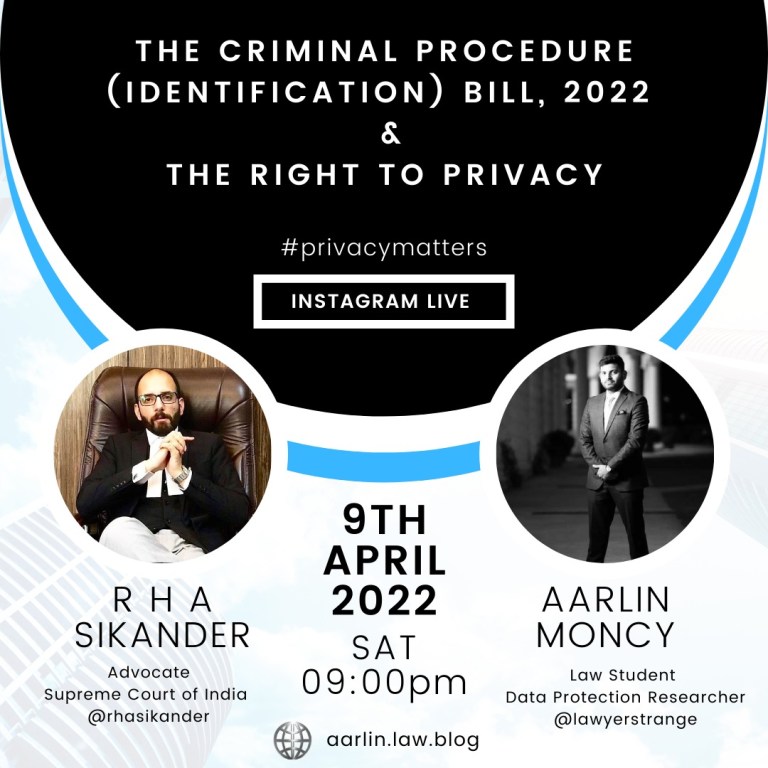
Discussion on- The Criminal Procedure (Identification) Bill, 2022 & the Right to Privacy

Join us tonight at 9 PM (Instagram Live), in conversation with R H A Sikander, practicing Advocate at the Supreme Court of India, where we discuss the two important Bills- The Criminal Procedure (Identification) Bill, 2022 & The Data Protection Bill, 2021

Instagram live link- https://www.instagram.com/lawyerstrange/

#CriminalProcedureIdentificationBill2022

#PrivacyMatters

Comparing the stance on Protection of Non-Personal Data in India and EU

First published on Tsaaro

Introduction & timeline of data protection in India

It is true that soon every business will become a tech business as “data” will be the new source of income. Managing and dealing with data of so many people by businesses and organisations, large or small, cannot be as easy as you may think. Leaving this area unregulated could lead to a global crisis from human rights violation to economic domination in the market, leading to endless privacy and cyber-crimes. Hence, regulating this area should be the prime focus of our nation’s government and any other country’s government where there is no privacy regulation. India recognised “privacy” as a fundamental right back in 2017 in a landmark decision passed by the Supreme Court in Justice K S Puttaswamy v. Union of India.

Right after the declaration of the “right to privacy” as a fundamental right, in July 2017, a Committee of Experts was constituted under the leadership of…continue reading

Can organizations monitor employees under the GDPR?

First published at Tsaaro Academy ( click here )

Introduction 

Do we have the right to privacy and can we enjoy it as a right especially upon our personal data when we are at our workplace? This is the fundamental question that this blog would be dealing with, from the perspective of the General Data Protection Regulation also known as GDPR.

Coming to the next important question as to what will come under the ambit of ‘personal data’? The simple answer would be- A personal data will include all the sensitive categories of data that are related to an identifiable natural person. The following are some examples of personal data-

  • Physical or mental health condition;
  • Sex life and sexual orientation;
  • Racial or ethnic origin;
  • Political opinions, religious beliefs;
  • Trade union membership;
  • Biometric data.

When it comes to monitoring employees, businesses and organizations are not new to this concept, rather the concept of surveillance is decades old. In order to understand and analyze this question, it is important to first understand the employee-employer relation, as we know that it’s an undisputed fact that there will always remain an imbalance of power between the two, which is why the concept of consent cannot be a relevant ground on claiming that such monitoring was genuine or not arbitrary.

Since we are living in the age of digitalization, we need to understand that anything we do either professionally or in our private sphere, we tend to leave our digital footprints on the internet which means that we can easily be traced by anyone and also we are opening doors to potential scammers and other related risks as our data is scattered everywhere on the internet that is also the reason why our ‘Data’ is the new gold/fuel for today’s businesses and organizations.

How is monitoring done on employees?

Monitoring of employees can be done easily through CCTVs, softwares and now we have spywares too. But what exactly will constitute ‘monitoring’ ? It can be monitoring an employee’s internet history, emails, financial transactions, call logs, his private chats with employees and/or with other people...continue reading